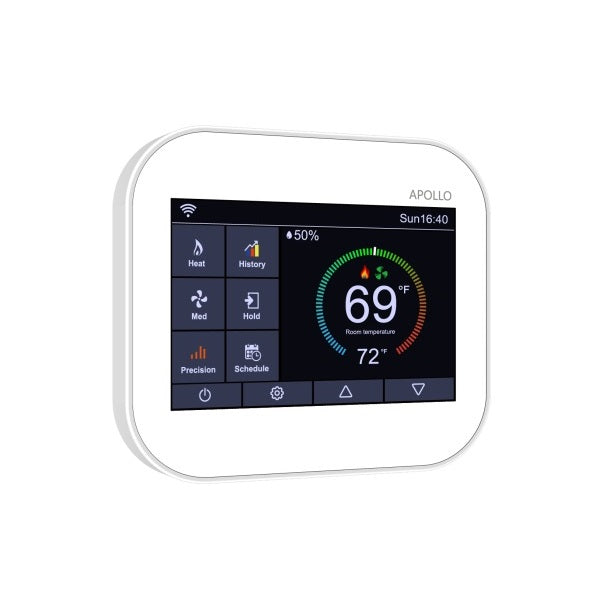
APOLLO Wi-Fi Fan Coil Thermostat
Shipping
$29
Free
 Skip to content
Track orders, manage your details, and sign in without a password.

SMART HVAC CONTROL, Built to Last
Smart Wi-Fi programmable thermostats and controls for HVAC heating and cooling systems, including fan coils, radiant floor heating, boilers, pool heating, snow melt, and electric heating applications.
Smart control | Wi-Fi thermostats | Complete systems
A smart Wi-Fi programmable thermostat is a connected HVAC control that manages heating or cooling equipment from a schedule, local temperature readings, and app-based adjustments. It lets the system run only when there is a real call for comfort instead of relying on fixed manual switching.
For MBTEK systems, thermostat choice depends on the equipment being controlled. Fan coils, radiant floors, boilers, aquastats, pool heating, snow melt, and electric heating all need the right control type, voltage, wiring, and sensor setup.
APOLLO Wi-Fi thermostats and controls are built for practical HVAC system control: hydronic fan coils, radiant floor zones, boilers, boiler aquastat logic, pool water temperature, snow melt operation, and electric heating applications.
Use this collection to choose the control by application first, then confirm voltage, wiring, sensor inputs, outputs, equipment compatibility, and installation requirements on the product page. MBTEK can help match controls to larger heating, cooling, and hydronic system layouts.
Start with the equipment being controlled. A fan coil thermostat, radiant floor thermostat, boiler control, aquastat, pool control, snow melt controller, and electric heating thermostat are not interchangeable.
Smart Wi-Fi thermostat
A smart Wi-Fi thermostat adds connected access to scheduling and local control. It can help users adjust settings from an app, check system status, and reduce unnecessary runtime when schedules change.
Programmable thermostat
A programmable thermostat follows a stored schedule. It is useful for predictable occupancy patterns, but it may not provide the same connected access or live adjustment options as a Wi-Fi control.
Thermostat
A thermostat typically controls space temperature for a room, zone, fan coil, radiant floor area, boiler call, or electric heating application.
Aquastat
An aquastat controls based on water temperature. It is commonly used for boiler water, hydronic water, pool heating, and other applications where water temperature is the control target.
Snow melt controller
A snow melt controller is used for outdoor surface heating systems and coordinates operation from slab, outdoor, and moisture-related inputs.
Before ordering a Wi-Fi thermostat or aquastat, verify the controlled equipment, voltage, wiring, relay logic, sensor requirements, mounting location, and whether the control needs to manage air temperature, floor temperature, water temperature, or outdoor operation. Have an HVAC professional confirm wiring before installation.
A smart Wi-Fi programmable thermostat can support energy savings by reducing unnecessary runtime, improving schedule control, and making it easier to adjust setpoints when conditions change. Actual savings depend on system type, climate, building load, setpoints, and user behavior.
For MBTEK systems, the strongest benefit is matching each control to the right equipment. A fan coil thermostat, radiant floor thermostat, boiler thermostat, aquastat, snow melt controller, and electric heating thermostat each manage a different part of the HVAC system.
Smart Wi-Fi Thermostat FAQ
Direct answers about programmable Wi-Fi thermostats, HVAC controls, aquastats, installation checks, energy savings, and MBTEK system fit.
A smart Wi-Fi programmable thermostat is a connected HVAC control that manages heating or cooling equipment from schedules, temperature readings, and app-based adjustments. It helps the system run based on comfort calls instead of constant manual switching.
A smart thermostat reads temperature, compares it with the selected setpoint, and sends a control signal to compatible HVAC equipment. Wi-Fi access lets users adjust schedules and settings from an app when the control is connected to a network.
A programmable thermostat follows stored schedules. A smart Wi-Fi thermostat also supports connected access, app-based changes, and status checks. Both can schedule equipment, but the connected control is easier to adjust when occupancy or comfort needs change.
Choose by application: fan coil thermostat for fan coils, radiant floor thermostat for floor heating, boiler thermostat for space-heating boiler calls, boiler aquastat for hydronic water temperature, pool aquastat for pool water temperature, snow melt controller for outdoor surface heating, and electric heating thermostat for compatible electric heating equipment.
No. A thermostat must match the equipment type, voltage, wiring, control outputs, sensors, and installation method. A fan coil, radiant floor zone, boiler, pool loop, snow melt system, and electric heating application may each require a different APOLLO control.
An aquastat is a control that responds to water temperature instead of room air temperature. It is used in boiler, hydronic, and pool-heating applications where the controlled value is water temperature.
Smart thermostats can help reduce energy use when scheduling, setpoints, and remote changes prevent unnecessary runtime. Savings depend on the HVAC system, climate, building load, insulation, controls setup, and how the thermostat is used.
Check the equipment type, voltage, wiring, relay outputs, sensor requirements, mounting location, network access, and product manual. Use a qualified HVAC professional when wiring, line voltage, boiler controls, or hydronic equipment is involved.