APOLLO Wi-Fi Radiant Floor Thermostat
Track orders, manage your details, and sign in without a password.
30% OFF ANY 3 ITEMS — EXTENDED TO JULY 15 Free Shipping 00d : 00h : 00m : 00s
Need help choosing?
Order online
Or call us for a complete-system quote and volume pricing.
Secure checkout · Free shipping
Complete the system
The radiant floor thermostat is the control layer for a hydronic system. Here are the components it connects to — and what buyers often add to build a complete radiant floor install.
Radiant floor distribution
Even heat across every loop
Distributes warm water evenly to each radiant floor zone. The thermostat controls the valve; the manifold station distributes the flow.
View details
Supply water temperature
Keep slab water in the safe range
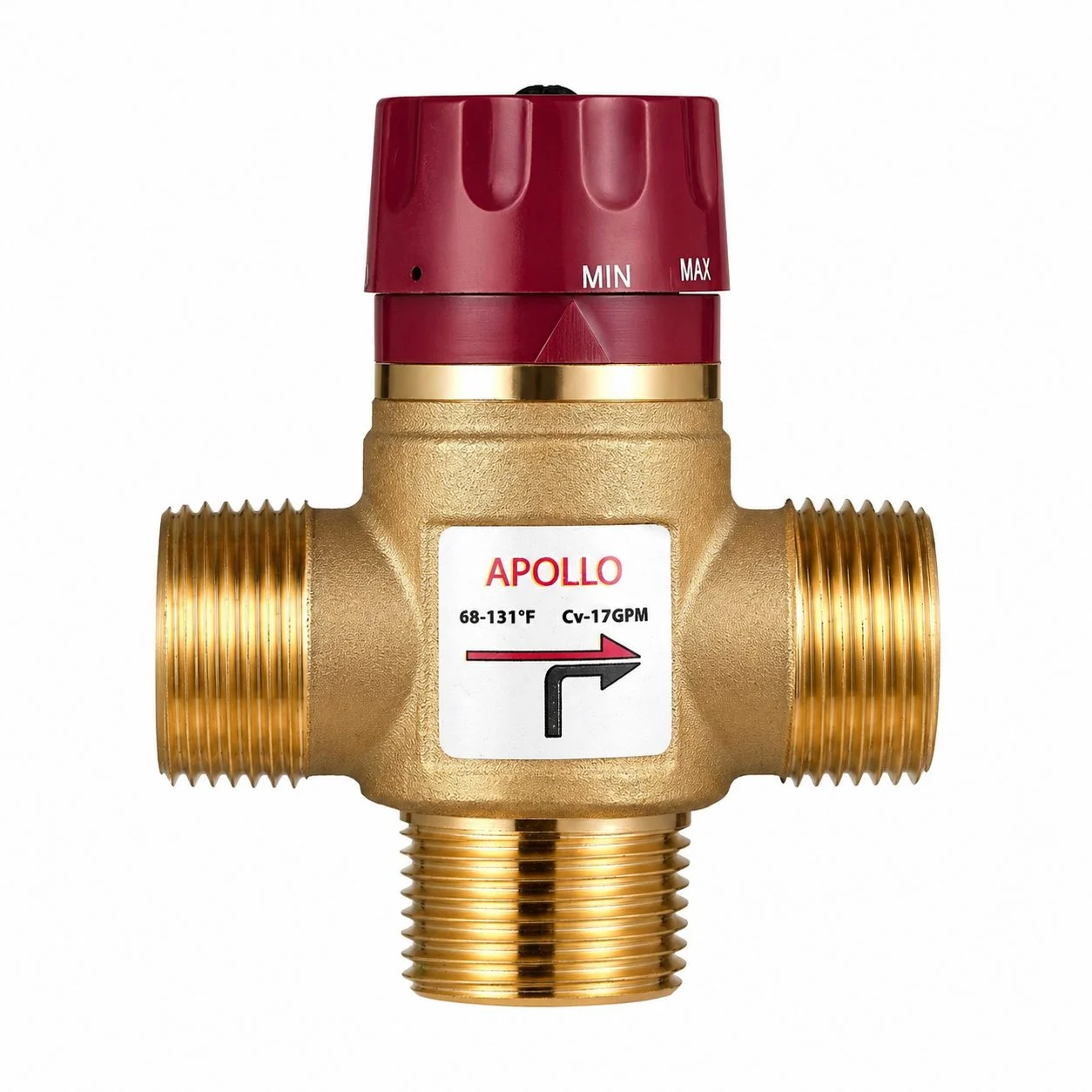
A mixing valve blends hot supply water down to a safe radiant floor temperature, protecting tile, wood, and laminate flooring.
View details
Required heat source
The heat pump that supplies hot water
Radiant floors need a hydronic loop supplied with hot water. Our Apollo air-to-water heat pumps drive that loop year-round.
View details
Shop complete systems
Many customers start with a thermostat and end up building a full hydronic system. See everything we carry to heat, cool, and supply hot water from one outdoor unit.
Hydro Station
A simpler mechanical room
Combines pump, controls, and electric backup into one compact wall station — less loose parts, faster install, cleaner mechanical room.
View details
Water Heater Tank
Hot water from the same system
The combined buffer and indirect tank lets the heat pump supply household hot water with no separate water heater needed.
View details
Heating & cooling delivery
Fan coils for forced-air comfort
Wall, concealed, ceiling, or floor units heat and cool rooms with the same water as the radiant floors. Pick the style that fits each space.
View details
APOLLO Wi-Fi Radiant Floor Thermostat
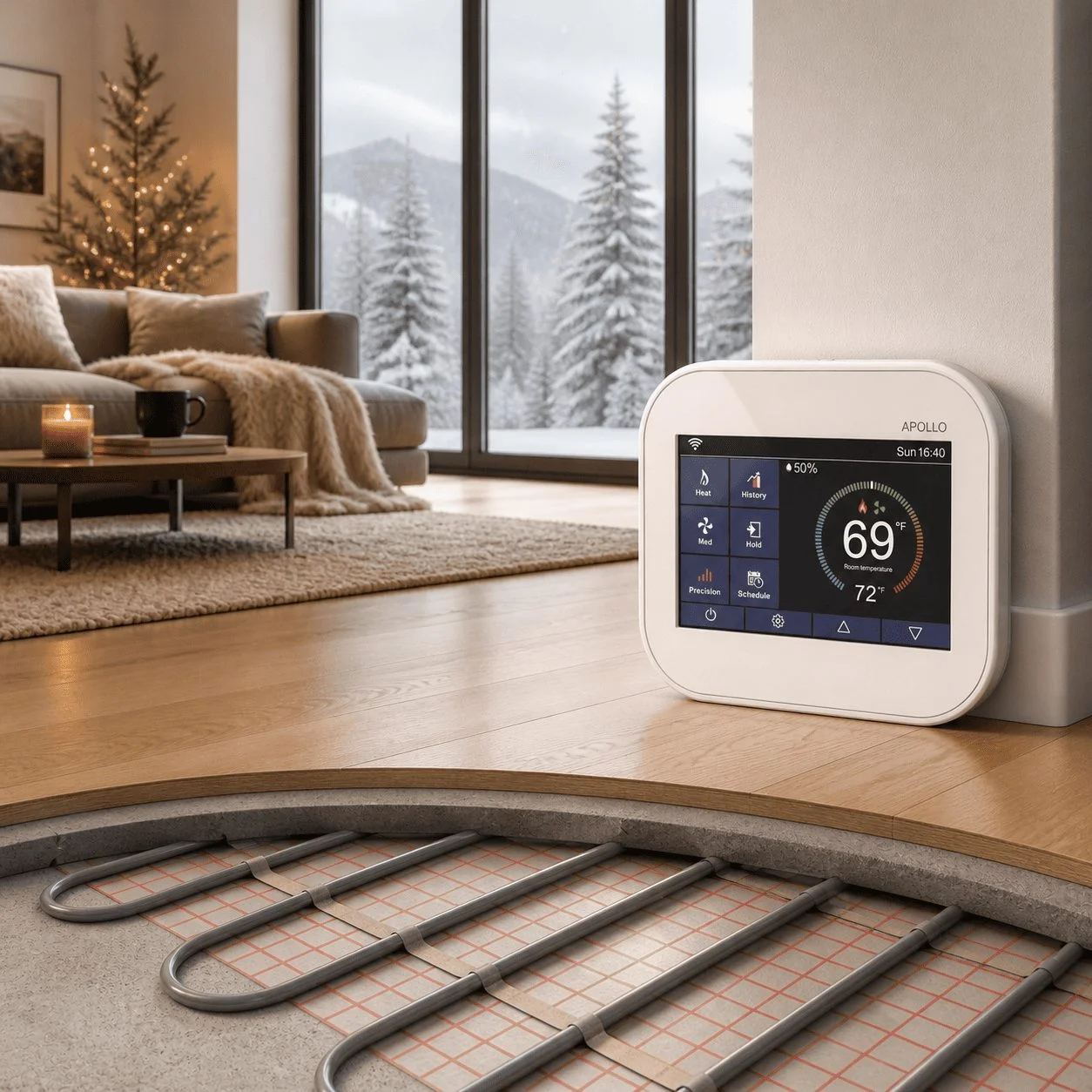
A hydronic thermostat for radiant floor heat that drives a motorized zone valve, circulator pump, or boiler call for 1-stage heat / 1-stage cool systems, on 12-24VAC/DC or 110-240VAC power.
Features a 3.5-inch power-saving TFT color touch screen for responsive control and a modern user experience.
Adds Wi-Fi connectivity for remote control, monitoring, and IoT integrations, with Google Home monitoring support.
Uses advanced GEO-fence technology to automate comfort settings based on the user's location, timed around the floor's slow thermal response.
A radiant heat thermostat with a floor sensor built in: the included 20 ft external probe reads floor, remote room, or outdoor temperature, protecting flooring from overheating.
Provides a multilingual interface translated into 7 languages for broader deployment flexibility.
The APOLLO Wi-Fi Radiant Floor Thermostat supports both 12-24VAC/DC and 110-240VAC power sources, helping it fit a wide range of hydronic control environments.
Advanced GEO-fence automation and adaptive scheduling adjust thermostat behaviour around the slab's thermal lag, improving comfort while reducing unnecessary runtime.
The included 20 ft external floor sensor reads floor, remote room, or outdoor temperature directly, so this hydronic radiant heat thermostat with floor sensor input tracks the surface being heated rather than just room air.
Combines real-time floor-sensor monitoring, connected control, and certified thermostat hardware into one platform for responsive, installer-ready radiant floor management.
Specifications for the APOLLO Wi-Fi Radiant Floor Thermostat, a hydronic radiant heat thermostat with floor sensor input.
| Purpose of control | Hydronic radiant floor heating — 1-stage heat / 1-stage cool motorized valve, pump, or boiler call |
|---|---|
| Supply voltage | 12 to 24VAC/DC or 110 to 240VAC |
| Relay rating | 5 Amp maximum per relay |
| Output relay | SPST - NO |
| Display | 320 x 480 TFT capacitive touch screen |
| Communications | Wi-Fi, BACnet/IP, wired BACnet MSTP, and MQTT |
| Wi-Fi / security | IEEE 802.11 b/g/n 2.4GHz with WPA/WPA2 |
| Dimensions / enclosure | 96 x 86 x 13.8 mm, built-in depth 24.5 mm, up to 200 g, IP21, PC + ABS plastic |
| Sensor | External 20 ft sensor for radiant floor, remote room, or outdoor use |
Hydronic control only — not rated to switch electric heating cable or mat loads directly.
Manuals and install guides for the APOLLO Wi-Fi Radiant Floor Thermostat.
Product manual for setup, operation, and connected thermostat features.
Wi-Fi radiant floor thermostat for hydronic floor heating applications, combining floor-sensor support, touchscreen control, and remote access on the APOLLO thermostat platform.
Replace 120V Honeywell T6570, T6069, T6169, TB6575A, TB6575B, TB6575A1000, T6575D, T6575C, T6574B
Replace 12 to 24VAC/DC Honeywell T8570, TB8575A, TB8575A1000, T8574B, T8575C, T8575D
Replace 12 to 24VAC/DC Coleman Rv Camper Mach Thermostat 7330G3351, 6636-3441, 7330F3852, 8330-3362, 9430-3372
Radiant Floor Thermostat FAQ
Answers about hydronic vs. electric radiant heat, floor sensors, wiring, and Wi-Fi features for in-floor heating.
A radiant floor thermostat controls hydronic in-floor heating rather than a furnace or air handler. Instead of a simple on/off call, it switches a motorized zone valve, circulator pump, or boiler call for 1-stage heat / 1-stage cool, timed around the slab's thermal lag. Because concrete or tile stores heat, the thermostat reads floor temperature directly through an external sensor rather than relying on room air alone — the APOLLO Wi-Fi Radiant Floor Thermostat ships with a 20 ft external sensor, accepts 12–24VAC/DC or 110–240VAC power, and adds Wi-Fi app control on top.
Hydronic radiant heat circulates hot water through PEX tubing in the slab; the thermostat switches a motorized valve, circulator pump, or boiler call. Electric radiant heat uses resistive heating cable or mats embedded in the floor; the thermostat switches that electric load directly through its relay and must carry built-in GFCI protection. The APOLLO Wi-Fi Radiant Floor Thermostat is a hydronic-only controller — it drives a 1-stage heat / 1-stage cool motorized valve and does not have GFCI protection. If you have electric heating cables or mats, you need a thermostat rated to switch the electric heating load directly through its relay — a different product from this one.
Yes. Slab and tile have enough thermal mass that air-only sensing overshoots or undershoots the actual floor temperature, wasting energy and risking overheated flooring. The APOLLO thermostat includes an external 20 ft sensor that can be placed in the floor, at a remote room location, or outdoors, so the setpoint tracks the surface you're actually heating rather than just the surrounding air.
No. Nest, Ecobee, and similar mainstream smart thermostats are built for single-stage forced-air furnaces and air conditioners — they have no floor-sensor input terminal and no logic for the slow thermal response of a heated slab, and they aren't wired to properly drive a hydronic zone valve or circulator relay. A dedicated hydronic radiant thermostat like the APOLLO, with a floor sensor input and valve-switching relay logic, is required for correct operation.
Yes. The APOLLO thermostat connects to a 2.4GHz network using IEEE 802.11 b/g/n with WPA/WPA2 security. The companion app lets you adjust the setpoint, view floor and room temperature, manage 7-day schedules, and set up GEO-fence automation from your phone. Wired BACnet MSTP, BACnet/IP, and MQTT are also supported for building management system integration, along with Google Home for voice-based monitoring.
It depends on your comfort with electrical work. Installation involves wiring the thermostat to its 12–24VAC/DC or 110–240VAC power supply, connecting the relay to your zone valve, circulator, or boiler call, and routing the external floor sensor into the slab or subfloor. This is a reasonable DIY project for anyone comfortable with low-voltage control wiring who follows the wiring diagram in the product manual — but a licensed electrician or hydronic technician is recommended for line-voltage hookups, multi-zone systems, or where local code requires a permit.
Prioritize a floor sensor input rather than air-only sensing, a power supply that matches your wiring (12–24VAC/DC or 110–240VAC), a relay rated for your zone valve or circulator load (the APOLLO is rated 5A maximum, SPST-NO), Wi-Fi app control, and scheduling that accounts for the slab's slow response — geofence and adaptive recovery matter more here than on forced-air systems. For commercial or multi-zone jobs, wired BACnet MSTP, BACnet/IP, or MQTT support for building management system integration is also worth checking.
A concrete or tile slab has enough thermal mass that it heats and cools far more slowly than air, so the aggressive on/off cycling used by forced-air thermostats will overshoot the setpoint or waste energy short-cycling the zone valve. Radiant floor schedules work better with an earlier pre-heat ramp before occupancy rather than a sharp setpoint jump. The APOLLO thermostat's 7-day scheduling, GEO-fence setback, and auto-detect mode (using built-in ambient light and humidity sensors) are tuned to work with that lag rather than against it.
The APOLLO Wi-Fi Radiant Floor Thermostat works with hydronic loops supplied by an air-to-water heat pump, or by an oil, gas, or electric boiler. It's part of the same APOLLO thermostat platform as the fan coil thermostat, boiler thermostat, boiler aquastat, pool/spa aquastat, snow melt controller, and electric baseboard thermostat — if you're building a multi-zone system with both fan coils and radiant floor loops, select the matching model from the dropdown at the top of this page for each zone type.