 Skip to content
Track orders, manage your details, and sign in without a password.
- No password required
- We send a secure 6-digit code to your email
- New email? Signing in creates your account automatically


FREE SHIPPING

Pool Heater Size Calculator
Find the right BTU for your swimming pool heat pump
Calculate My Pool SizePool Heat Pump BTU Calculator
Enter your pool dimensions and heating goals — results update automatically.
Your Results
Estimated Heat-up Time
| Unit | Output | Est. Time for Your Pool |
|---|---|---|
| Apollo 3.5T (Air-to-Water) | 48,000 BTU/h | — |
| Apollo 4T (Geothermal) | 48,000 BTU/h | — |
| Apollo 5T (Air-to-Water) | 60,000 BTU/h | — |
| Apollo 6T (Air-to-Water) | 72,000 BTU/h | — |
| Apollo 6T (Geothermal) | 72,000 BTU/h | — |
EVI Advantage: All Apollo air-to-water units maintain reliable output down to −10°C (14°F) — ideal for extending your swimming season into early spring and late fall.
Very large pool or want faster heat-up? Running two heat pumps in parallel doubles BTU output — halving heat-up time without oversizing a single unit. Our team can design a dual-unit setup for your pool.
Need help choosing or sizing your system? Our team sizes pool heating systems for free — no obligation.
Top picks for your pool
Compare Our Two 6-Ton Units
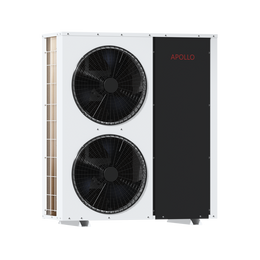
APOLLO Central Heat Pump - 72k btu / 6 ton - Air to Water
72,000 BTU/h — 6 Ton
EVI outdoor unit draws heat from ambient air. No ground loop required. Operates to −10°C. Best for above-ground or standard in-ground pools where ground-loop installation isn’t practical.
View Product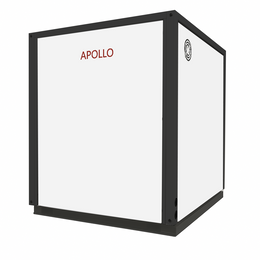
APOLLO Geothermal Heat Pump - 72k btu / 6 ton - Water to Water
72,000 BTU/h — 6 Ton
Water-to-water unit draws from a ground loop for consistent COP year-round. Unaffected by cold air. Best for large pools or properties with an existing or planned geothermal loop.
View ProductFull Lineup
Air-to-Water Heat Pumps
EVI technology — works to −10°C
APOLLO Central Heat Pump - 42k btu / 3.5 ton - Air to Water
48,000 BTU/h — 3.5 Ton
Smaller pools or extended heat-up windows.
View Product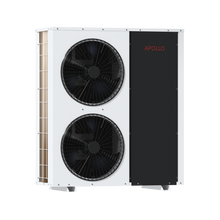
APOLLO Central Heat Pump - 60k btu / 5 ton - Air to Water
60,000 BTU/h — 5 Ton
Medium pools. Solid 24 hr heat-up performance.
View Product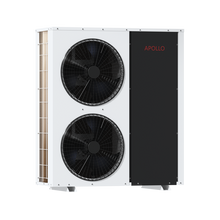
APOLLO Central Heat Pump - 72k btu / 6 ton - Air to Water
72,000 BTU/h — 6 Ton
Maximum output. Most popular for year-round pool heating.
View Product⚠ Air-to-water units connect to a closed hydronic loop — a titanium or cupro-nickel heat exchanger is required between the unit and your pool water.
Geothermal Heat Pumps
Water-to-water — consistent output year-round via ground loop
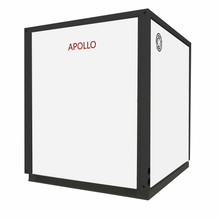
APOLLO Geothermal Heat Pump - 48k btu / 4 ton - Water to Water
48,000 BTU/h — 4 Ton
Ground-loop efficiency for small to medium pools. Steady output regardless of air temperature.
View ProductAPOLLO Geothermal Heat Pump - 72k btu / 6 ton - Water to Water
72,000 BTU/h — 6 Ton
Maximum geothermal output. Ideal for large pools or multi-season operation with ground-loop stability.
View ProductPool Heat Pump FAQ
What size pool heat pump do I need?
The right size depends on pool volume, desired temperature rise, and how quickly you want to heat up. The standard formula is BTU/h = (gallons × 8.34 × temperature rise °F) ÷ heating hours, with a 25% buffer for ongoing heat loss.
As a rule of thumb, a typical 15×30 ft pool (~17,000 gallons) heated 15°F over 24 hours needs roughly 60,000–72,000 BTU/h. Use the calculator above for your exact pool, then browse our Apollo air-to-water lineup to match your result to a unit.
How long does it take a pool heat pump to heat a swimming pool?
Initial heat-up takes 24–72 hours depending on pool size, temperature rise, and heat pump capacity. The heat-up time table in the calculator above shows the exact estimate for your pool across all three Apollo air-to-water sizes.
Once at target temperature, maintaining it uses far less energy — the heat pump only compensates for daily losses from evaporation, wind, and radiation. Contact us if you need help choosing the right capacity for your heat-up timeline.
Does a pool cover reduce the size of heat pump I need?
Yes, significantly. A pool cover reduces evaporative heat loss — which accounts for up to 70% of total pool heat loss — by around 30% on average. Toggle the pool cover option in the calculator above to see exactly how much it shifts your BTU requirement.
A cover can mean the difference between needing a 5T or 6T unit. See BTU specs across our Apollo lineup once you have your adjusted number.
What is COP and how does it affect pool heating efficiency?
COP (Coefficient of Performance) measures heat delivered per unit of electricity consumed. A COP of 4.0 means 4 kWh of heat for every 1 kWh of electricity. The Apollo air-to-water series typically achieves COP 3.5–5.0 for pool heating, making running costs significantly lower than gas or electric resistance heaters.
For even higher year-round COP, geothermal heat pumps draw from a stable ground-loop source instead of outdoor air, maintaining peak efficiency regardless of ambient temperature.
Can I heat my pool in early spring or late fall with an air-to-water heat pump?
Standard heat pumps lose efficiency below 10°C (50°F) and stop below 5°C. The Apollo EVI series maintains reliable output down to −10°C (14°F), extending your pool season into early spring and late fall at a fraction of gas heating costs.
Do I need a heat exchanger to connect an air-to-water heat pump to my pool?
Yes. Air-to-water units heat a closed hydronic loop and do not connect to open pool plumbing directly. A titanium or cupro-nickel heat exchanger transfers heat to the pool water while protecting the unit from chlorine and bromine damage.
Contact us for help selecting a compatible heat exchanger for your pool setup.
What if my pool requires more than 72,000 BTU/h?
Two approaches work well. Running two Apollo 6T air-to-water units in parallel on a shared hydronic loop is scalable and straightforward to expand. Alternatively, a geothermal heat pump connected to a ground loop delivers consistent high output year-round, unaffected by outdoor air temperature — ideal for large pools or properties with existing geothermal infrastructure.
Our team will design the right system for your pool at no charge — call 1-888-301-0737 or use the Contact Us button above.